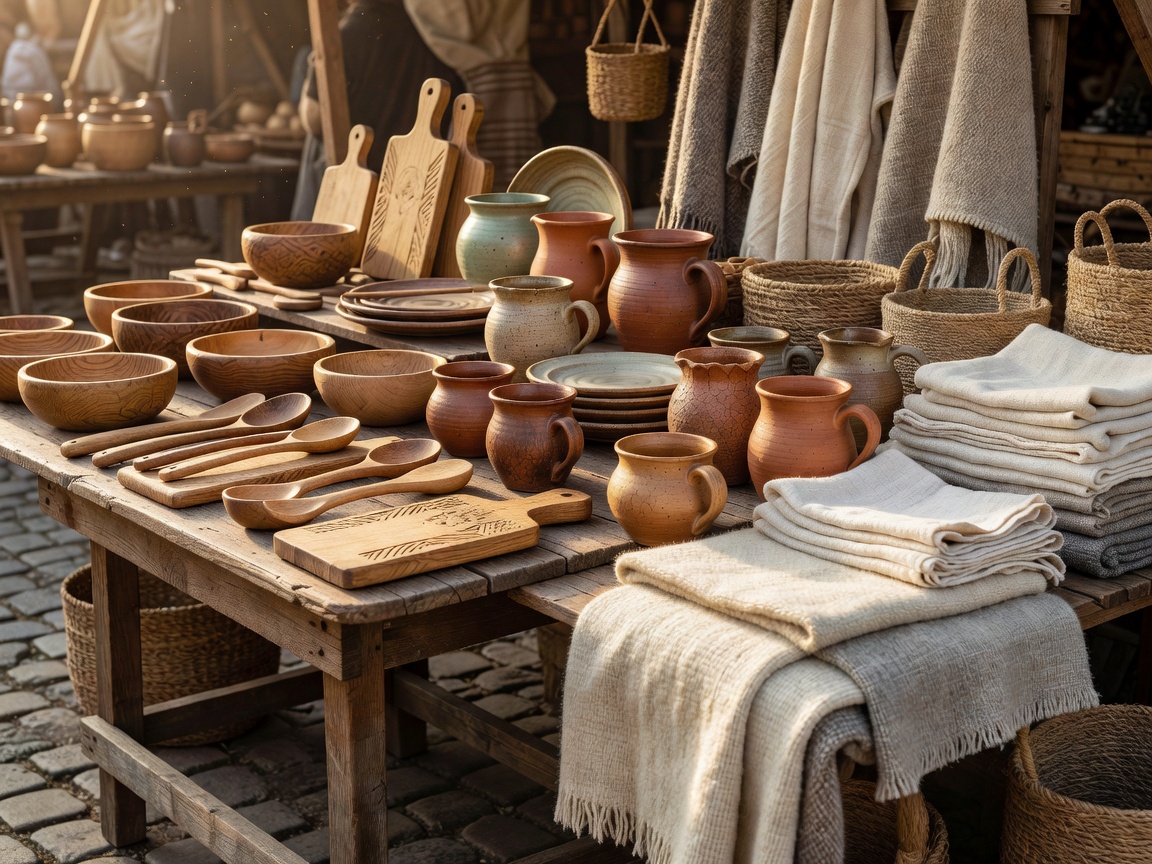
Craft categories in the market
Craft markets can bring together woodworking, textiles, ceramics, woven goods, decorative objects and practical household items. Some stalls sell work made by the person behind the table. Others represent a workshop, stock goods from several makers or offer products designed elsewhere. A market’s theme does not establish the origin of every object.
Regional craft traditions are not static. Contemporary makers may adapt familiar forms, materials or motifs for current use. New design does not make an object less considered, and an old-fashioned appearance does not prove a long local history. Treat claims about place, process and age as details to check.
Four useful distinctions
- Locally made: Ask where the item was produced and who made it. A seller’s presence at a local market does not itself establish local production.
- Regional-style: The design may refer to local visual language but may be manufactured elsewhere. Ask how the maker describes it.
- Imported souvenir: It may be a useful keepsake, but its point of production can differ from the place represented.
- Contemporary craft: New methods and forms can sit alongside inherited techniques. Ask about materials and process rather than assuming a style tells the whole story.
Wood, textile and ceramic goods
For woodwork, check finish, joins, intended use and care instructions. If the item is presented as made locally, ask who made it and where. Avoid assuming that a carved motif identifies a specific village or maker.
For textiles and woven goods, inspect fiber labels, construction and care guidance. Ask whether the object is handwoven, machine-made or finished by hand if that distinction matters to you. Terms may not have one consistent meaning across sellers.
For ceramics, look for information about material, glaze, food suitability and washing. Decorative ceramics are not automatically safe for food use. Follow the maker’s instructions and ask for written guidance when possible.
Practical selection criteria
Start with function. Decide whether you want a decorative object, a household item or a compact gift. Check dimensions, weight, fragility and how you will carry it. Compare finish and construction across similar items. Ask what care it needs and whether replacement or repair information is available.
For provenance, ask neutral questions: “Where was this made?” “Who made it?” “What materials are used?” “Is there a label or maker card?” Clear answers are useful, but the atlas does not verify individual sellers. Do not treat an unsubstantiated authenticity claim as a guarantee.
Transport and purchase planning
Bring a reusable bag with protective wrapping if you expect to buy fragile goods. Keep receipts and maker information with the object. Check baggage limits and cross-border rules for materials where relevant. Larger or fragile purchases may require a shipping option; confirm costs, packaging and responsibility directly with the seller before agreeing.
Prices and payment methods vary. This guide does not provide price benchmarks. Ask for the full amount and accepted payment method before purchase. If an item is sold as handmade, ask what part of the process is handmade rather than relying on a label alone.
Good for
- Visitors seeking useful household objects or locally represented design.
- People comparing materials and making methods.
- Travelers who want to buy carefully and carry items safely.
What to know
- Market location and regional styling do not prove where an item was made.
- Contemporary craft can reinterpret older forms.
- Check maker details, materials, care instructions and intended use.