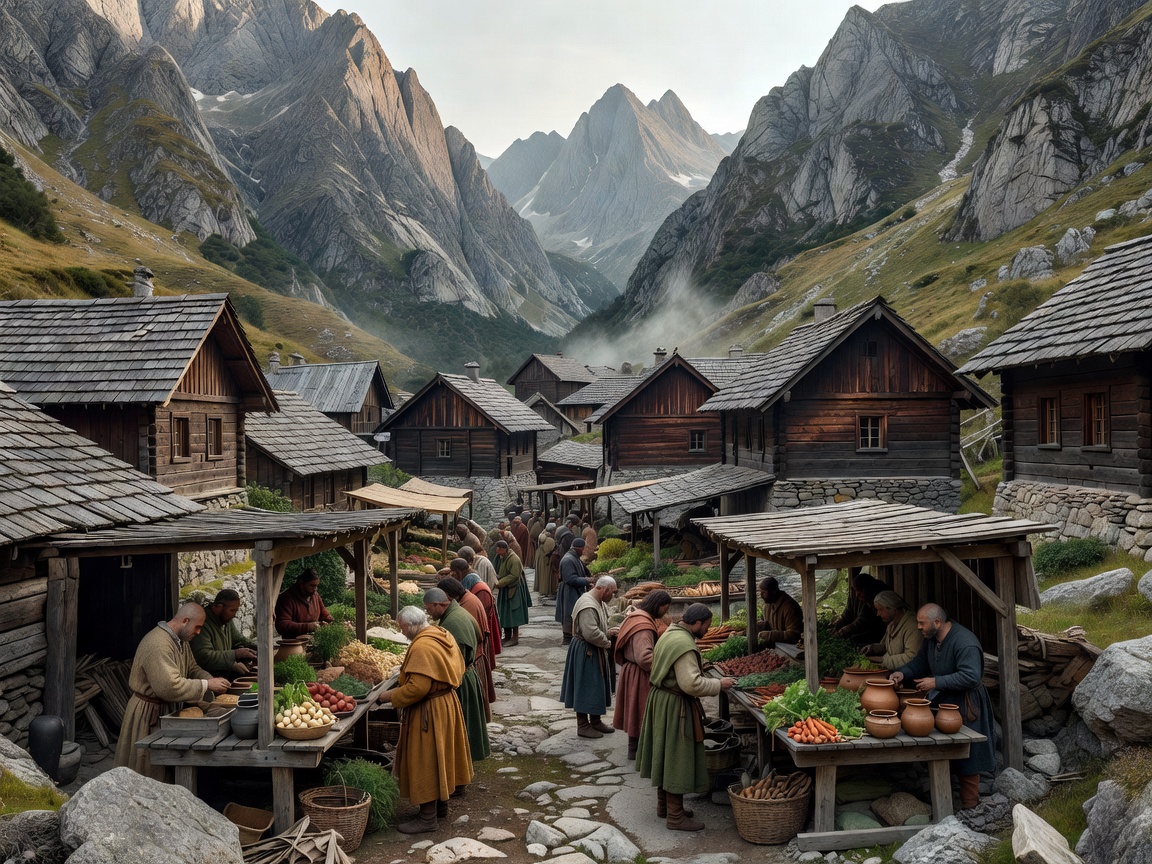
Markets follow routes and settlement
Alpine Europe is not one uniform market region. It spans multiple countries, languages, elevations and agricultural systems. A market in a broad valley may serve a chain of settlements and be reachable by road or rail. A smaller mountain village market may be shaped by a narrow valley, limited flat ground and a short local supply chain.
Markets often gather around practical civic spaces: a central square, a covered hall, a transport interchange or a street closed for an event. The location affects the mix of shoppers, visitors, food sellers and craft stalls. It also affects access. A compact square close to a station works differently from a seasonal event reached by a steep lane.
Valley communities and mountain settlements
Valley markets can draw from more farms, workshops and transport links. They may offer a broader range of goods, but scale varies. A larger site does not guarantee more local producers, and a small market is not automatically more representative of its region. Check the organizer’s current description and look for clear information about sellers and product origin.
Higher settlements face shorter growing seasons and more demanding transport. Their markets may emphasize stored foods, durable goods, local specialties or event-based trading. Seasonal production differs by altitude and exposure. Even neighboring villages can have different growing conditions.
Border regions and shared traditions
Modern borders do not always match historical foodways, language areas or trading routes. Mountain passes and valley corridors have connected communities over time, while state boundaries may divide them today. A product or market custom can therefore feel familiar across a border without being identical. Names, ingredients, rules and selling practices can still differ.
Use regional labels as starting points, not proof of a single tradition. Ask where an item was made or grown. Read the label. When information matters, check local-language market notices or ask the organizer. This approach is more reliable than assuming that a broad regional style identifies a product’s origin.
Mountain and lowland market comparison
Mountain setting
- Travel can involve steep streets, limited parking or infrequent connections.
- Weather and elevation can affect outdoor formats.
- Supply may be seasonal and locally specific.
Valley or lower setting
- Connections between settlements may be more direct.
- A larger catchment can create a wider stall mix.
- Busy routes may bring congestion at peak times.
Scale, agriculture and useful comparison
Market size is only one useful measure. Consider the number of stalls, the share of food sellers, the balance between regular trade and special events, and the distance between market and production areas. Local agriculture reflects slope, soil, water, climate and available land. Some communities can support a range of fresh crops. Others rely more heavily on dairy, orchard products, stored goods or trade from nearby lower ground.
For a regional comparison, record the market setting, transport options, event format and product categories. Do not infer opening hours or dates from a general pattern. These details change by organizer and season. Confirm them using a current official market or municipal source before setting out.
Good for
- Visitors comparing village settings before choosing a route.
- People interested in cross-border food traditions.
- Travelers who want to match market scale with access needs.
What to know
- Mountain geography can make short distances slow to travel.
- Regional identity does not confirm the origin of every stall product.
- Current dates, access arrangements and seller lists need local verification.